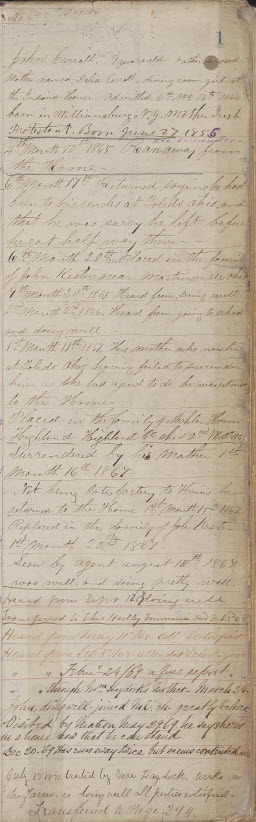
My first sentence about an event in the life of John Carroll sounds simple enough:
On an exceptionally hot day in June 1863, John Carroll’s mother told her five-year-old son that she would be back soon.
However, this sentence has presented me with two conundrums. The first was his age.
According to the records of the Children’s Home (a Cincinnati institution that placed homeless and destitute youngsters into country homes), John was nine years old when he was admitted on June 14, 1864. The records give his birthdate as June 27, 1855, and I suppose they can be forgiven for being off a couple weeks on his age. If that birthdate was indeed correct, John would have been only eight years old when he entered the Home rather than nine.
Except that his age might have been off by more than a couple weeks. It might have been off by three years. As an adult, John affirmed that he was born on June 27, but his 1920 passport and other documents give his birth year as 1858. That would have made him five years old rather than eight at the time of his admission.
So how did the Children’s Home come up with 1855? After telling John she would be back soon, his mother never returned, so she could not have provided them with his birthdate. Did John tell the managers of the Home that he was born in 1858 and they wrote it down wrong? Did he tell them he was born in 1855 and he himself was wrong, given that he was a young child at the time, and his true birth year came to light later? Did he not know the year of his birth, and the managers took their best guess? Could adults who worked regularly with children not be able to tell a five-year-old from an eight-year old?
Another key discrepancy presented me with the second conundrum. John eventually became a successful railroad lawyer, and an 1890 newspaper article described his rags-to-riches tale. The story was picked up nationally, and John soon received a letter from a woman in New York who claimed to be his mother’s sister. He immediately went to visit her, and she shared with him a letter from a Cincinnati hospital. According to that letter, John’s mother suffered a sunstroke on the day that she left him, and she died within hours. Hence my sentence began, On an exceptionally hot day.
Except that the Children’s Home records tell a different story. An entry dated January 11, 1867, says that John’s mother, who was then living in Toledo, failed to surrender him to the Home as she had agreed to do. However, she finally did so five days later.
John had spent years of his childhood and adulthood searching for his mother. Did he ever ask the Children’s Home for more information about himself? Did they tell him that at one point his mother was alive and living in Toledo, and he couldn’t confirm it, or couldn’t believe it? Had the Home contacted the wrong person?
I don’t know. And although I normally trust institutional records, especially Quaker records like these, I decided to believe John. He was five years old. And it was an exceptionally hot day.
 Sabrina Darnowsky
Leave a comment