For all the hubbub about the potential dangers of artificial intelligence (AI)–and I acknowledge that they’re real–I have to admit that I have found using Anthropic’s Claude AI tremendously helpful with the book I’m currently writing.
To be clear–I don’t let Claude do any of my writing for me. I still do all of that myself. However, I find Claude to be an extraordinary resource. I currently have three “projects” set up for my interactions with Claude: Miscellaneous Conversations, Letter Transcriptions, and Chapter Feedback.
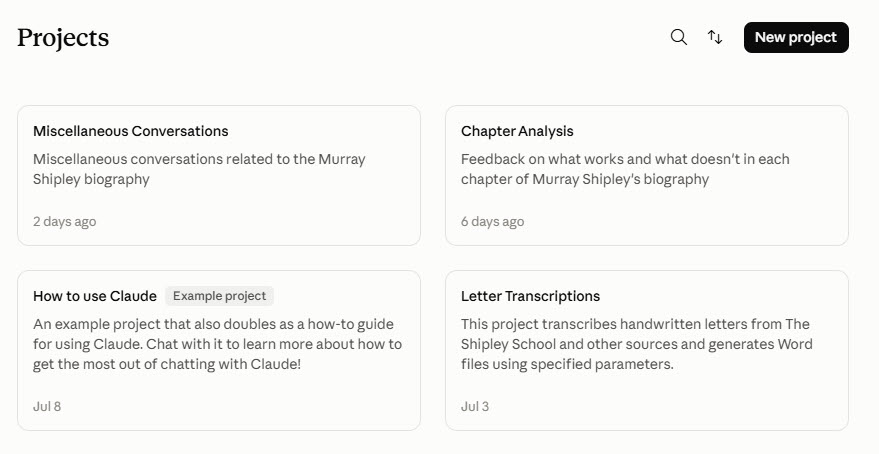
Miscellaneous Conversations is for chats about anything from how Quakers privately observed Christmas in the 1870s to the best way to structure a chapter that has two separate narratives occurring on the same timeline.
Sometimes Claude knows when I need information even when it never occurred to me to ask the question. For example, in my biography of a 19th-century Quaker minister, Murray Shipley, I mentioned that Murray became a “special partner” in a particular business enterprise. Claude then shared with me the intricacies of 19th-century Ohio law regarding the differences between a “general partnership” and a “special partnership,” and told me the name of the regulatory book where I could double-check the details myself and include an appropriate footnote for the information. I did the writing, but Claude pointed me toward material that I didn’t know existed.
The Letter Transcriptions project is for exactly what it sounds like. I have hundreds and hundreds of pages of handwritten family correspondence that can take hours and hours to read and transcribe myself. I tried to use Transkribus in the past, but found it woefully inadequate. It may have improved over the years, but I have found Claude’s ability to read and transcribe handwritten manuscripts to be both fast and accurate. He even saves me from the dreadful task of trying to read “cross-writing”–the practice of writing vertically on a page that already has horizontal text. He’s even aware that these letters were written by Quakers, so the occurrences of thee and thou and thine don’t trip him up. And when he can’t make out a particular word or phrase, he flags it rather than making any assumptions. Then I can manually check the issue against the original manuscript and hopefully figure it out. This feature alone will save me weeks if not months of work.
My last project, Chapter Feedback, is again exactly what it sounds like. When I finish each chapter, I upload my Word file and Claude reads through it, producing his own written review of what works well (every writer needs a stroke now and again), what doesn’t work well, what I might need to research further, what details don’t help the narrative arc, etc. It’s like having a writer’s support group or a professional developmental editor at my beck and call, 24/7. Claude occasionally makes suggestions, and we talk through them, but ultimately I’m the one who makes all the decisions.
I know I’ve been inconsistent about how I handle my footnotes, and when the whole book is done, I’ll be asking Claude to review all of them and identify the ones that need to be fixed. Perhaps I’ll also have him review the index and make suggestions for entries that didn’t occur to me!
I couldn’t have written this biography if it weren’t for the availability of digitized books on sites like HathiTrust.org and Archive.org, as well as other scanned material on Ancestry.com, FamilySearch.org, and other websites. I consider Claude yet another tool for helping writers to do their best work, not do their work for them.


Leave a Reply